
Industrial Firefighting Solutions in Abu Dhabi: What You Need to Know for Effective Fire Safety
Industrial operations in Abu Dhabi face unique fire safety challenges due to complex processes, valuable assets and strict regulatory oversight. This guide delivers expert insight into industrial firefighting solutions in Abu Dhabi, covering regulations, system options, proactive risk management, partner selection and emerging technologies. Readers will learn how Abu Dhabi Civil Defense (ADCD) standards shape compliance, which detection and suppression systems suit each facility, and how to embed preventive maintenance and emergency planning. Finally, you’ll discover criteria for choosing an ADCD-approved contractor and the latest IoT, AI and eco-friendly advances in fire protection.
What Are the Key Fire Safety Regulations and Compliance Requirements in Abu Dhabi?
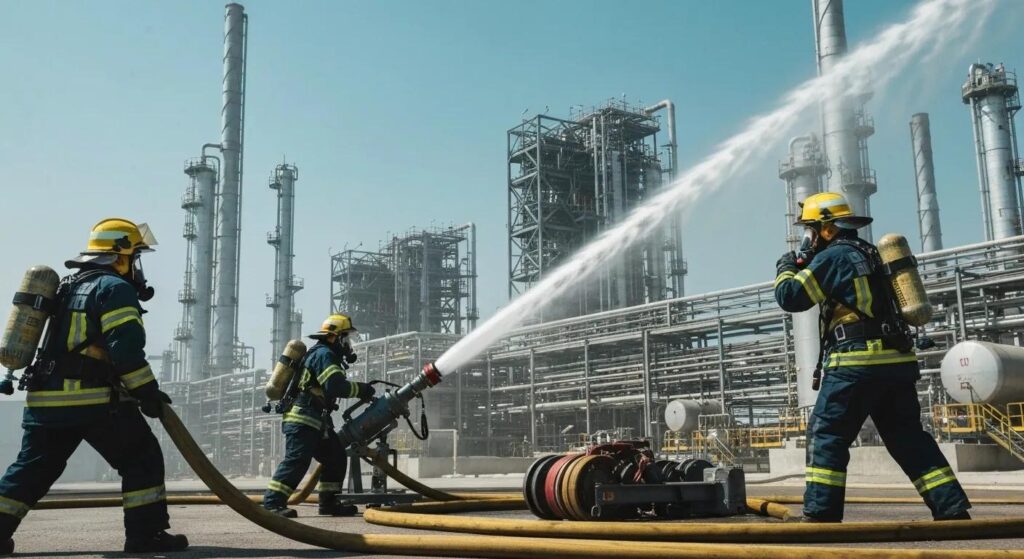
Effective fire safety in Abu Dhabi hinges on adherence to national codes, ADCD mandates and internationally recognized standards. Facilities must secure certification, implement approved system designs and maintain ongoing compliance through inspections and maintenance contracts.
Key Fire Safety Regulations and Compliance in Abu Dhabi
Effective fire safety in Abu Dhabi requires adherence to national codes, Abu Dhabi Civil Defense (ADCD) mandates, and internationally recognized standards. Facilities must obtain certification, implement approved system designs, and maintain ongoing compliance through inspections and maintenance contracts [21].
This source emphasizes the importance of compliance with local regulations and codes to ensure fire safety in Abu Dhabi, which aligns with the article’s focus on regulations and compliance.
What Is the Role of Abu Dhabi Civil Defense (ADCD) in Industrial Fire Safety?
The Abu Dhabi Civil Defense Authority regulates and enforces all fire safety measures in industrial settings, issuing permits, conducting site audits and responding to emergencies. As a governmentOrganization, ADCD sets minimum design requirements, approves system layouts, and collaborates with accredited contractors to safeguard personnel and property.
The Role of Abu Dhabi Civil Defense (ADCD)
The Abu Dhabi Civil Defense Authority regulates and enforces all fire safety measures in industrial settings, issuing permits, conducting site audits, and responding to emergencies [20]. As a government organization, ADCD sets minimum design requirements, approves system layouts, and collaborates with accredited contractors to safeguard personnel and property.
This source highlights the role of the Abu Dhabi Civil Defence in establishing preventive safety requirements, which supports the article’s discussion of ADCD’s role in industrial fire safety.
Which UAE Fire and Life Safety Codes Apply to Industrial Facilities?
Listed below are the principal codes governing industrial fire protection in Abu Dhabi and their core requirements.
| Code Reference | Scope | Key Requirement |
|---|---|---|
| NFPA 1 | Fire Prevention and Life Safety | Written fire safety plans |
| NFPA 13 | Sprinkler Systems | Hydraulic calculations and coverage |
| NFPA 72 | Fire Alarm and Signaling | Notification appliance locations |
| NFPA 86 | Industrial Furnaces and Ovens | Exhaust and suppression for ovens |
| NFPA 101 | Life Safety Code | Egress design and occupancy classifications |
These standards define system design, installation and performance metrics that facilities must meet before ADCD approval.
UAE Fire and Life Safety Codes
The UAE Fire and Life Safety Code of Practice outlines strict guidelines for industrial fire protection [24]. Facilities must install and maintain certified fire alarm systems, fire extinguishers, suppression systems, emergency lights, exit signage, and undergo regular inspections and system testing [24].
This source supports the article’s discussion of the UAE Fire and Life Safety Code and its requirements for industrial fire protection, which is a key aspect of the article.
How Do You Obtain and Maintain ADCD Certification for Industrial Sites?
To secure and renew ADCD certification, an industrial facility must:
- Submit design drawings, equipment specifications and fire safety plans to ADCD.
- Complete a site inspection by certified ADCD inspectors.
- Address any non-conformities and obtain final approval.
- Enroll in an Annual Maintenance Contract (AMC) for regular system servicing.
- Renew certification before expiry by verifying maintenance logs and inspection reports.
Following this step-by-step process, including guidance from the “How to Get a Civil Defense Certificate in Abu Dhabi?” resource, ensures continuous compliance and operational readiness.
Obtaining and Maintaining ADCD Certification
To secure and renew ADCD certification, an industrial facility must submit design drawings, equipment specifications, and fire safety plans to ADCD, complete a site inspection, address any non-conformities, obtain final approval, enroll in an Annual Maintenance Contract (AMC), and renew certification before expiry [27].
This source provides information on the process of obtaining a fire safety permit, which is relevant to the article’s discussion of ADCD certification.
What Types of Industrial Firefighting Systems Are Used in Abu Dhabi?
Industrial facilities rely on integrated detection, active suppression and passive measures to create multi-layered protection against fire events.
What Are the Main Fire Detection Systems for Industrial Facilities?
Early fire detection is critical to prevent escalation. Industrial sites commonly use:
- Smoke detectors that sense airborne particulates.
- Heat detectors calibrated to temperature rise or fixed thresholds.
- Flame detectors using ultraviolet or infrared sensors.
These systems feed into a centralized fire alarm panel for immediate notification and response coordination.
Main Fire Detection Systems for Industrial Facilities
Industrial sites commonly use smoke detectors, heat detectors, and flame detectors for early fire detection [19]. These systems feed into a centralized fire alarm panel for immediate notification and response coordination.
This source supports the article’s discussion of fire detection systems, which is a key aspect of the article.
How Do Active Fire Suppression Systems Work: Water, Foam, and Clean Agents?
Active suppression relies on a fluid medium to extinguish fires quickly. The table below compares major options:
| System Type | Extinguishing Medium | Application | Advantage |
|---|---|---|---|
| Wet Pipe Sprinkler | Water | General manufacturing | Rapid response and low cost |
| AFFF Foam | Foam concentrate | Hydrocarbon storage areas | Superior flammable liquid control |
| FM-200 Clean Agent | HFC-227ea | Telecom and data centers | Zero residue and equipment safe |
| Inergen | Inert gas mixture | Control rooms | Human-safe and no environmental impact |
Selecting the appropriate system depends on hazard classification, asset sensitivity and environmental considerations.
Active Fire Suppression Systems
Active suppression relies on a fluid medium to extinguish fires quickly, with options including wet pipe sprinklers, AFFF foam, FM-200 clean agents, and Inergen [25]. Selecting the appropriate system depends on hazard classification, asset sensitivity, and environmental considerations.
This source supports the article’s discussion of active fire suppression systems, which is a key aspect of the article.
What Passive Fire Protection Measures Are Essential in Industrial Settings?
Passive measures contain fire and maintain structural integrity without activation:
- Fire-rated doors and shutters to compartmentalize areas.
- Fire-resistant walls, ceilings and insulation to limit spread.
- Intumescent coatings on steel structures to prevent collapse.
These features complement active systems by extending escape time and protecting critical infrastructure.
How Can Industrial Facilities Manage Fire Risks Proactively in Abu Dhabi?
Preventing fires begins with thorough assessment, diligent maintenance and robust emergency planning.
What Is the Process for Industrial Fire Risk Assessment?
A systematic risk assessment identifies hazards, evaluates vulnerabilities and recommends controls. Key steps include:
- Surveying facility layout and operational processes.
- Identifying potential ignition sources and fuel loads.
- Analyzing worst-case fire scenarios and impact.
- Prioritizing mitigation measures based on risk severity.
A comprehensive assessment lays the groundwork for targeted fire safety improvements and policy updates.
Why Is Preventive Maintenance Critical for Fire Safety Systems?
Routine maintenance ensures all components function reliably when needed. Essential activities include:
- Testing alarm circuits, detectors and notification devices.
- Inspecting sprinklers, valves and pump performance.
- Verifying foam proportioners and agent concentrations.
- Updating calibration and software in smart monitoring systems.
ADCD mandates Annual Maintenance Contracts to confirm that safety investments remain effective over time.
Preventive Maintenance for Fire Safety Systems
Routine maintenance ensures all components function reliably when needed, including testing alarm circuits, detectors, and notification devices, inspecting sprinklers and valves, and verifying foam proportioners [28]. ADCD mandates Annual Maintenance Contracts to confirm that safety investments remain effective over time.
This source supports the article’s discussion of preventive maintenance, which is a key aspect of the article.
How to Develop Effective Emergency Preparedness and Evacuation Plans?
Emergency plans provide clear procedures and roles for fire incidents. Core components involve:
- Defined escape routes and assembly points for each shift.
- Communication protocols and alarm activation steps.
- Assigned responsibilities for floor wardens and safety officers.
- Regular drills, training sessions and plan reviews.
Well-practiced evacuation routines minimize downtime and protect lives during critical events.
How to Choose a Trusted Industrial Firefighting Company in Abu Dhabi?
Selecting the right contractor aligns expertise with ADCD requirements and project complexity.
What Criteria Define an ADCD Approved Fire Safety Contractor?
An accredited contractor must hold valid ADCD licenses, demonstrate:
- Proven experience with industrial fire protection projects.
- In-house design, installation and commissioning capabilities.
- A certified maintenance team for AMC execution.
- Strong track record of compliance and timely inspection support.
These qualifications ensure consistent service quality and regulatory alignment.
ADCD Approved Fire Safety Contractor
An accredited contractor must hold valid ADCD licenses and demonstrate proven experience with industrial fire protection projects, in-house design, installation, and commissioning capabilities, a certified maintenance team, and a strong track record of compliance [6]. These qualifications ensure consistent service quality and regulatory alignment.
This source supports the article’s discussion of ADCD approved fire safety contractors, which is a key aspect of the article.
Who Are the Leading Industrial Firefighting Providers in Abu Dhabi?
Top providers include:
- Amples Fire and Safety LLC, specializing in certification guidance and AMC management.
- NAFFCO, known for large-scale system manufacturing and turnkey installations.
- Louis Fire Safety, offering rapid response maintenance and training programs.
Each brings distinct strengths in equipment, compliance expertise and emergency support.
What Are the Emerging Technologies Shaping Industrial Fire Safety in Abu Dhabi?
New technologies enhance detection accuracy, response speed and environmental sustainability.
How Are IoT and AI Enhancing Fire Detection and Emergency Response?
IoT sensors continuously monitor temperature, smoke and pressure in real time, while AI analytics:
- Predict potential system faults by identifying abnormal patterns.
- Prioritize alerts based on risk scoring algorithms.
- Optimize evacuation guidance through dynamic route mapping.
These smart solutions reduce false alarms and accelerate decision-making in critical moments.
IoT and AI Enhancing Fire Detection and Emergency Response
IoT sensors continuously monitor temperature, smoke, and pressure in real time, while AI analytics predict potential system faults, prioritize alerts, and optimize evacuation guidance [5]. These smart solutions reduce false alarms and accelerate decision-making in critical moments.
This source supports the article’s discussion of how IoT and AI are enhancing fire detection and emergency response, which is a key aspect of the article.
What Sustainable and Eco-Friendly Fire Suppression Solutions Are Available?
Environmental concerns drive adoption of:
- Water mist systems that use fine droplets for efficient heat absorption with minimal water usage.
- Next-generation clean agents with low global warming potential (GWP).
- Biodegradable foam concentrates that decompose naturally after use.
Such options protect assets and reduce ecological impact without sacrificing performance.
Industrial firefighting in Abu Dhabi requires an integrated approach spanning compliance, system design, preventive management and continuous innovation. By aligning with ADCD regulations, selecting the right detection and suppression technologies, and partnering with accredited specialists, facilities can minimize risk and ensure operational resilience. Emerging IoT, AI and sustainable agents further strengthen fire preparedness, safeguarding people and property in Abu Dhabi’s dynamic industrial landscape.