
Firefighting Services Abu Dhabi for Industrial Safety: Comprehensive Solutions and Civil Defense Compliance
Industrial sites in Abu Dhabi confront unique fire hazards—from flammable chemicals to high-voltage equipment—and require specialized firefighting services that ensure both asset protection and regulatory compliance. This article outlines how integrated fire protection systems, Abu Dhabi Civil Defense (ADCD) approval processes, adherence to the UAE Fire and Life Safety Code, specialized risk management services, and ongoing maintenance deliver robust industrial safety. Readers will learn which suppression technologies are essential, how to navigate ADCD certification, why code compliance matters, what tailored services support prevention and response, and how regular maintenance safeguards operations.
What Are Firefighting Services for Industrial Safety in Abu Dhabi?
Firefighting services for industrial safety in Abu Dhabi encompass design, installation, and commissioning of active and passive fire protection systems that comply with ADCD regulations. These services integrate detection, suppression, emergency planning, and civil defense liaison to reduce fire risk and support uninterrupted operations. Establishing these systems lays the groundwork for regulatory approval and long-term industrial resilience.
Which Fire Protection Systems Are Essential for Industrial Facilities?
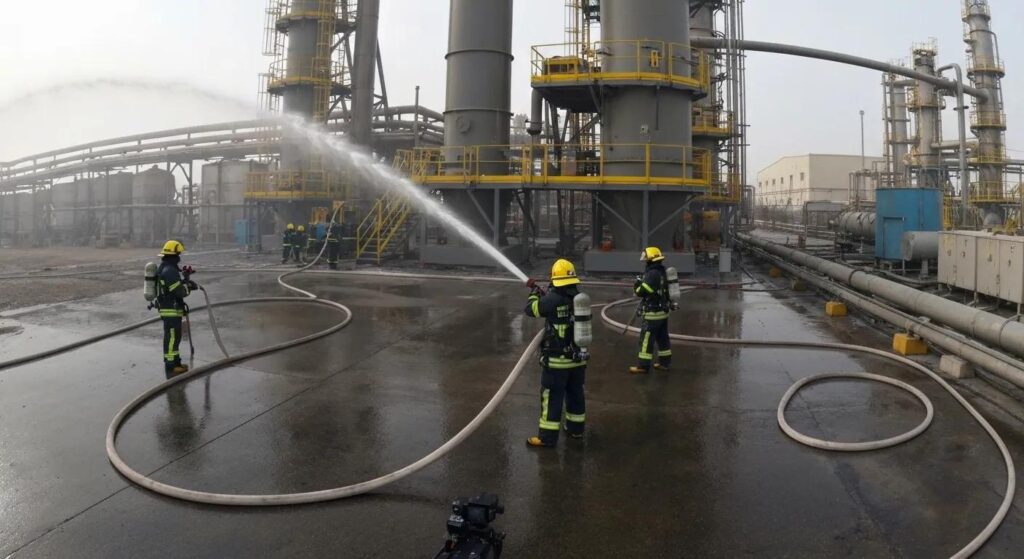
Industrial facilities rely on a combination of detection and suppression solutions to manage diverse hazards.
| System Type | Key Feature | Primary Benefit | Why Essential |
|---|---|---|---|
| Water Sprinkler Networks | Automatic wet-pipe activation | Rapid area cooling and flame control | Meets UAE Fire and Life Safety Code |
| Gas Suppression Systems | Clean-agent discharge (FM-200/Novec) | Protects sensitive equipment without residue | Critical in electrical and control rooms |
| Fire Alarm Panels | Multi-zone detection and alerts | Early warning with monitoring integration | Enables prompt evacuation and response |
| Emergency Lighting | Battery-backed LED fixtures | Illuminates exit paths during power loss | Supports safe egress under smoke |
Each system addresses specific risk categories and creates layers of protection that dovetail into broader industrial safety strategies.
How Do Fire Alarm and Suppression Systems Work in Industrial Settings?
Fire alarm systems detect smoke, heat, or flame using interconnected sensors that trigger visual and audible alerts. Upon alarm confirmation, suppression systems—either water-based or gas-based—activate automatically, isolating the fire source and limiting damage. These mechanisms link back to central control panels for real-time monitoring, tying directly into Abu Dhabi Civil Defense’s incident response network and enabling rapid dispatch of qualified firefighting teams.
How to Obtain Abu Dhabi Civil Defense Approval for Industrial Firefighting Services?
Securing ADCD approval is mandatory before commissioning fire protection systems in industrial facilities. This certification verifies that design drawings, equipment specifications, and installation practices meet the UAE Fire and Life Safety Code and ADCD guidelines. Achieving approval protects assets, ensures legal compliance, and accelerates project handover.
ADCD Regulations and Fire Safety
The Abu Dhabi Civil Defence (ADCD) is the primary authority for fire safety regulations in Abu Dhabi, setting standards for fire prevention, emergency response, and safe building operation. Business owners must secure ADCD approvals to ensure their systems meet these standards.
This source directly supports the article’s emphasis on the importance of ADCD approval for industrial firefighting services.
What Are the Step-by-Step Requirements for ADCD Approval?
- Submit detailed fire safety drawings and system schematics to ADCD.
- Provide manufacturer certificates for key components (e.g., sprinklers, alarms).
- Pay application fees and register the facility on the ADCD portal.
- Schedule and pass a site inspection that verifies proper installation.
- Obtain the final ADCD compliance certificate.
Completing these steps in order streamlines certification and integrates civil defense readiness into industrial operations.
Which Documents Are Needed for Industrial Fire Safety Certification?
- Building floor plans with fire system layouts.
- Equipment datasheets and third-party testing certificates.
- Trade license and engineering consultant approval.
- Fire safety calculation reports (hydraulic, occupancy).
- As-built installation drawings.
For detailed guidance on compiling and submitting these materials, see How to Get a Civil Defense Certificate in Abu Dhabi for industry-specific insights and checklist-driven assistance.
Why Is Compliance with UAE Fire and Life Safety Code Critical for Industrial Facilities?
Compliance with the UAE Fire and Life Safety Code ensures that every component of a facility’s firefighting strategy—from detection sensitivity to egress capacity—meets uniform national standards. Adhering to these regulations reduces liability, aligns operations with insurance requirements, and reinforces workplace safety culture.
UAE Fire and Life Safety Code
The UAE Fire and Life Safety Code of Practice is a key document guiding fire safety efforts in the UAE. The code aims to prescribe minimum guidelines for the design, construction, and installation of fire protection systems to achieve safer societies.
This citation supports the article’s discussion of the UAE Fire and Life Safety Code and its impact on firefighting services.
How Does the UAE Fire and Life Safety Code Impact Firefighting Services?
The code dictates design criteria such as minimum sprinkler densities, corridor widths, alarm response times, and materials’ fire-resistance ratings. Firefighting service providers must tailor system specifications to fulfill these mandates, ensuring that suppression capacity and detection coverage are calibrated to industrial risk profiles.
What Are the Key NFPA Standards Relevant to Abu Dhabi Industrial Safety?
| Standard | Focus Area | Core Requirement |
|---|---|---|
| NFPA 13 | Sprinkler System Design | Prescribes hydraulic calculation methods |
| NFPA 72 | National Fire Alarm Code | Defines alarm signal protocols and testing |
| NFPA 25 | Inspection, Testing, Maintenance | Establishes AMC schedules for systems |
NFPA Standards in Industrial Safety
NFPA codes and standards are essential in sectors like chemicals, oil and gas, and manufacturing for managing fire hazards. They offer a detailed framework covering fire prevention, detection, suppression, and emergency response.
This source supports the article’s discussion of NFPA standards and their relevance to industrial safety.
What Specialized Firefighting Services Are Available for Industrial Facilities in Abu Dhabi?
Beyond core system deployment, industrial clients benefit from comprehensive risk management and emergency preparedness services. Firefighting firms offer tailored assessments, planning, and training modules that address the complexity of large-scale operations.
How Are Fire Risk Assessments Conducted for Industrial Sites?
Risk assessments combine hazard identification, probability analysis, and consequence evaluation to map fire scenarios across production lines, storage areas, and utility spaces. Specialists use industry-standard methodologies to deliver actionable mitigation plans, prioritizing high-risk zones for enhanced protection measures and resource allocation.
What Emergency Planning and Training Services Are Offered?
Providers deliver custom emergency response plans, live-fire drills, evacuation simulations, and certification courses for on-site personnel. These programs reinforce situational awareness, instill proper use of extinguishers, and ensure teams can coordinate effectively with civil defense responders during incidents.
How Does Regular Maintenance Ensure Industrial Fire Safety in Abu Dhabi?
Ongoing maintenance verifies system readiness and sustains performance levels mandated by both NFPA and ADCD. Proactive upkeep extends equipment lifespan, prevents failures, and demonstrates a commitment to continuous safety improvement.
What Are the Benefits of Annual Maintenance Contracts (AMC) for Fire Systems?
Annual maintenance contracts guarantee scheduled inspections, functional testing, and preventive repairs for all fire protection components. This structured approach minimizes downtime, helps budget for safety expenditures, and maintains compliance records required for insurance renewals.
How Does 24/7 Emergency Fire Support Protect Industrial Facilities?
Round-the-clock emergency response services provide immediate technical assistance and troubleshooting, addressing false alarms, sensor malfunctions, or suppression deployment issues. This continuous support framework reduces incident escalation and ensures uninterrupted protection for critical industrial assets.
Industrial operations in Abu Dhabi achieve optimal safety and regulatory alignment by integrating advanced fire protection systems, securing timely ADCD approvals, and adhering to the UAE Fire and Life Safety Code. Specialized risk assessments and emergency training complement robust maintenance strategies to create a holistic firefighting service portfolio. Partnering with experienced providers ensures that industrial facilities not only meet compliance benchmarks but also cultivate proactive safety cultures that safeguard lives and investments.