
Fire Safety Compliance Essentials for Abu Dhabi Businesses: How to Meet Regulations and Protect Your Business
A single fire incident can halt operations, damage assets, and endanger lives, making fire safety compliance in Abu Dhabi a critical priority for every business. This guide explains the core regulations enforced by the Abu Dhabi Civil Defense Authority, outlines the Civil Defense Certificate application, details mandatory protection systems, describes fire risk assessments and emergency planning, and shows how to maintain ongoing compliance. By mastering these essentials, companies safeguard employees, avoid penalties, and ensure uninterrupted operations.
What Are the Key Fire Safety Regulations for Businesses in Abu Dhabi?
Fire safety regulations in Abu Dhabi require businesses to obtain approvals, install compliant systems, and maintain ongoing inspections to protect life and property. These rules form the foundation for every subsequent compliance step.
Key Fire Safety Regulations
Fire safety regulations in Abu Dhabi require businesses to obtain approvals, install compliant systems, and maintain ongoing inspections to protect life and property [6]. These rules form the foundation for every subsequent compliance step.
This source provides an overview of the fire safety regulations and permit requirements in Abu Dhabi, which is relevant to the article’s discussion of fire safety compliance.
What Role Does the Abu Dhabi Civil Defense Authority Play in Fire Safety?
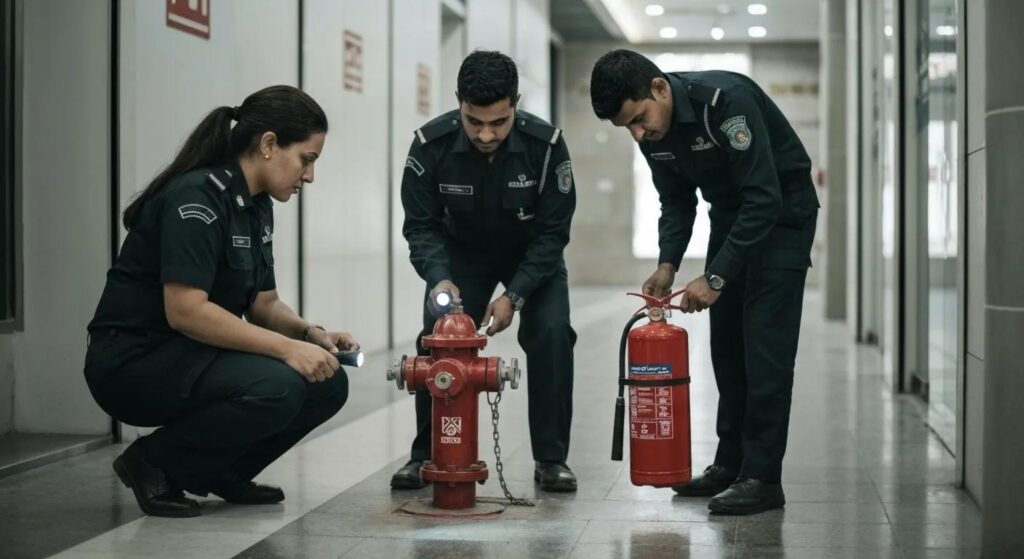
The Abu Dhabi Civil Defense Authority (ADCDA) regulates and enforces fire and life safety standards across commercial premises, issuing permits and conducting audits to verify adherence. As the primary authority, ADCDA evaluates building plans, inspects installed systems, and grants or withholds the Civil Defense Certificate based on compliance status, ensuring businesses meet legal and safety obligations.
Abu Dhabi Civil Defense Authority (ADCDA)
The Abu Dhabi Civil Defense Authority (ADCDA) regulates and enforces fire and life safety standards across commercial premises, issuing permits and conducting audits to verify adherence [6]. As the primary authority, ADCDA evaluates building plans, inspects installed systems, and grants or withholds the Civil Defense Certificate based on compliance status, ensuring businesses meet legal and safety obligations.
This source directly supports the article’s statements about the role of the ADCDA in enforcing fire safety standards.
How Does the UAE Fire and Life Safety Code of Practice Affect Your Business?
The UAE Fire and Life Safety Code of Practice establishes uniform requirements for fire prevention, detection, suppression, and evacuation in all building types. Aligning with this code means adopting standardized materials, layouts, and system specifications that ADCDA inspects during plan review and site audits, thereby reducing the risk of non-compliance fines and enhancing occupant safety.
UAE Fire and Life Safety Code of Practice
The UAE Fire and Life Safety Code of Practice establishes uniform requirements for fire prevention, detection, suppression, and evacuation in all building types [8]. Aligning with this code means adopting standardized materials, layouts, and system specifications that ADCDA inspects during plan review and site audits, thereby reducing the risk of non-compliance fines and enhancing occupant safety.
This source provides information on the UAE Fire and Life Safety Code of Practice, which is essential for understanding fire safety regulations in Abu Dhabi.
Which NFPA Standards Are Adopted in Abu Dhabi Fire Safety Compliance?
Below is an overview of key NFPA standards integrated into Abu Dhabi’s regulatory framework.
| Standard | Scope | Application |
|---|---|---|
| NFPA 72 | Fire alarm and signaling | Design and installation of detection systems |
| NFPA 13 | Sprinkler systems | Automatic sprinkler layout and performance |
| NFPA 101 | Life safety code | Egress requirements and occupancy classifications |
Each standard defines technical criteria that ADCDA enforces during inspections and system approvals, ensuring uniform protection levels across businesses. Understanding these benchmarks leads directly into the certificate application process.
NFPA Standards in Abu Dhabi
The National Fire Protection Association (NFPA) is a non-profit organization dedicated to reducing fire risks through research, education, and over 300 fire safety codes and standards [4]. In Abu Dhabi, Civil Defence mandates adherence to NFPA standards for fire protection systems, making compliance essential for building safety.
This source explains the importance of NFPA standards in Abu Dhabi, which is directly relevant to the article’s discussion of NFPA standards.
How Can Businesses Obtain a Civil Defense Certificate in Abu Dhabi?
Obtaining a Civil Defense Certificate is mandatory before commencing operations, as it confirms that fire safety measures comply with ADCDA regulations and NFPA standards.
Civil Defense Certificate Application
Obtaining a Civil Defense Certificate is mandatory before commencing operations, as it confirms that fire safety measures comply with ADCDA regulations and NFPA standards [7]. The application process involves compiling required documentation, submitting the application, scheduling and passing a site inspection, and receiving the certificate.
This source provides information on the Civil Defence Certificate application process, which is directly relevant to the article’s discussion of obtaining the certificate.
- Compile required documentation and approved building plans.
- Submit the application online or in person to ADCDA.
- Schedule and pass the site inspection conducted by ADCDA personnel.
- Receive the Civil Defense Certificate and display it on-site.
This streamlined four-step process ensures companies meet fire safety requirements and legal standards, paving the way for secure operations.
What Documents Are Required for the Civil Defense Certificate Application?
Before applying, businesses must gather:
- A valid trade license and tenancy contract.
- Approved architectural and engineering drawings.
- No Objection Certificates (NOCs) from relevant authorities.
- Specifications for installed fire protection systems.
What Is the Step-by-Step Process for ADCDA Approval?
The ADCDA approval journey follows these stages:
- Submission: Complete application form and upload documents.
- Payment: Settle the prescribed fee via ADCDA’s portal.
- Inspection: ADCDA inspects installed systems against submitted plans.
- Certification: Certificate is issued upon successful compliance.
Each phase demands clear documentation and compliant installations, which accelerates approval and certificate issuance. For comprehensive guidance on this procedure, see How to Get a Civil Defense Certificate in Abu Dhabi?
How Long Is the Civil Defense Certificate Valid and How to Renew It?
Certificates are valid for one year and require renewal through:
- Submission of a renewal application at least 30 days before expiry.
- Proof of scheduled maintenance contracts for fire systems.
- A follow-up inspection to verify system integrity.
Timely renewals sustain uninterrupted compliance and reinforce safety readiness.
What Types of Fire Safety Systems Are Mandatory for Abu Dhabi Businesses?
Abu Dhabi regulations mandate both active and passive measures, along with emergency lighting and signage, to ensure robust fire protection.
What Are Active Fire Protection Systems and Their Compliance Standards?
| System | Attribute | Value |
|---|---|---|
| Fire Alarm Systems | Detection Standard | NFPA 72 |
| Sprinkler Systems | Installation Guideline | NFPA 13 |
| Fire Extinguishers | Inspection Frequency | Quarterly |
These systems must be designed, installed, and maintained under NFPA criteria to satisfy ADCDA requirements and ensure rapid response during emergencies. Proper upkeep leads to reliable performance and regulatory approval.
How Do Passive Fire Protection Solutions Enhance Building Safety?
- Fire-rated walls and doors compartmentalize fire spread.
- Intumescent coatings seal gaps in structural joints.
- Fire dampers close duct openings to prevent smoke movement.
What Are the Requirements for Emergency Lighting and Exit Signage?
- Continuous illumination for egress routes must last at least 90 minutes.
- Photoluminescent exit signs require backup power and regular testing.
- Placement at every corridor intersection and stairwell exit.
Clear pathway marking and reliable backup power ensure safe evacuation under any conditions.
How Should Businesses Conduct Fire Risk Assessments and Emergency Planning in Abu Dhabi?
Effective fire risk assessments identify hazards and shape emergency response plans to protect people and property.
What Is the Process for Conducting a Comprehensive Fire Risk Assessment?
A robust assessment includes:
- Hazard Identification: Survey potential ignition sources and combustible materials.
- Risk Evaluation: Determine likelihood and impact of fire scenarios.
- Control Measures: Recommend active and passive protections.
- Documentation: Compile findings into a formal risk register.
Fire Risk Assessment
A Fire Risk Assessment (FRA) is a systematic examination of what in your job activities and workplace potentially puts people in danger from fire. The results of a FRA will serve to evaluate potential fire-related issues and provide guidance for resolving or mitigating them.
This source provides information on fire risk assessments, which is directly relevant to the article’s discussion of conducting fire risk assessments.
How to Develop an Effective Fire Evacuation and Emergency Response Plan?
- Define clear roles and responsibilities for staff.
- Map primary and secondary escape routes.
- Include assembly point procedures and accountability checks.
- Outline communication protocols with emergency services.
Well-structured plans ensure coordinated responses and fast, orderly evacuations during crises.
Why Is Regular Fire Safety Training Essential for Employees?
Fire safety training equips personnel with life-saving skills:
Fire Safety Training
Fire safety training equips personnel with life-saving skills, including the proper use of fire extinguishers and alarm activation. Ongoing drills and refresher courses maintain readiness and compliance with ADCDA training requirements.
This source provides information on fire safety training, which is directly relevant to the article’s discussion of fire safety training for employees.
How Can Businesses Maintain Ongoing Fire Safety Compliance in Abu Dhabi?
Sustained compliance hinges on routine inspections, audit preparation, and strategic partnerships with approved specialists.
What Are the Requirements for Regular Fire System Inspections and Maintenance?
ADCDA mandates:
- Quarterly checks for alarms, suppression systems, and extinguishers.
- Annual full-system certification by licensed contractors.
- Maintenance contracts that guarantee timely repairs and part replacements.
Consistent servicing preserves system integrity and demonstrates proactive safety management.
How to Prepare for ADCDA Inspections and Audits?
To streamline audits:
- Keep all certificates, test records, and maintenance logs organized.
- Conduct self-inspections using ADCDA checklists.
- Address deficiencies immediately with qualified technicians.
Preparedness reduces inspection delays and reinforces regulatory trust.
What Are the Benefits of Partnering with Approved Fire Safety Companies?
Collaborating with ADCDA-approved firms delivers:
- Expert guidance on evolving regulations.
- Efficient installation and testing of compliant systems.
- Priority service and direct coordination with regulatory inspectors.
Professional partnerships ensure businesses remain at the forefront of fire safety best practices and compliance standards.
Businesses that adopt these fire safety compliance essentials build resilient operations, safeguard lives, and secure regulatory confidence. Continuous attention to regulations, system integrity, and training transforms compliance from obligation to competitive advantage.