
How Long Does an Annual Fire Safety Inspection Take?
Annual fire safety inspections for commercial buildings in Abu Dhabi typically require one to three hours on-site, depending on building size and system complexity. ADCD compliance demands annual testing of sprinkler systems, fire alarms, and emergency equipment. Amples Fire & Safety LLC provides ADCD-approved inspection services across Abu Dhabi and Al Ain.
Key Takeaways
- Annual fire safety inspections for commercial buildings in Abu Dhabi typically require one to three hours on-site.
- Small commercial buildings with fewer than 50 devices complete inspection in 1 to 3 hours.
- Mid-size buildings with 50 to 200 devices require 4 to 8 hours for inspection.
- Large or high-rise buildings with 200 or more devices often need 1 to 3 full days.
What Does an Annual Fire Safety Inspection Cover?
An annual fire safety inspection covers the life safety code, fire prevention protocols, and certification processes. Abu Dhabi’s regulations set requirements for design, evacuation procedures, installation of fire protection systems, and emergency preparedness. Building managers and business owners must comply with specific local laws governing equipment installation, maintenance, and inspection.
The inspection scope extends across every fire protection system in a commercial property. Amples Fire & Safety LLC provides Civil Defense Approval (ADCD) services to guide facility managers through this process. Total Fire Protection delivers NICET-certified fire alarm inspection services across NYC and the Tri-State area. We test every system component to NFPA 72 and FDNY standards. Violations get corrected before they escalate into compliance failures. Documentation from the inspection satisfies inspectors and insurance carriers.
What Systems Does the Inspector Examine?
The inspection covers all installed fire protection systems and their operational readiness. Inspectors verify that equipment meets design specifications and regulatory requirements.
- Verify fire alarm control panels, detectors, and notification devices function correctly.
- Test fire sprinkler systems, including water supply, valves, and sprinkler heads.
- Inspect fire extinguishers for proper placement, pressure, and service tags.
- Review emergency lighting and exit signage for visibility and power backup.
- Confirm evacuation routes remain unobstructed and clearly marked.
What Documentation Results from the Inspection?
The inspection produces formal documentation that demonstrates regulatory compliance. This record serves as evidence for ADCD approval and insurance requirements. Facility managers retain these documents for annual renewal and audit purposes. A detailed guide on key steps for commercial fire safety inspection outlines the full compliance process in Abu Dhabi.
How Do Certification Processes Fit In?
Certification processes confirm that fire protection systems meet Abu Dhabi’s life safety code. The inspection verifies design compliance, installation quality, and ongoing maintenance records. Emergency preparedness protocols receive review alongside physical equipment checks.
How Long Does an Annual Fire Safety Inspection Typically Take for Commercial Properties?
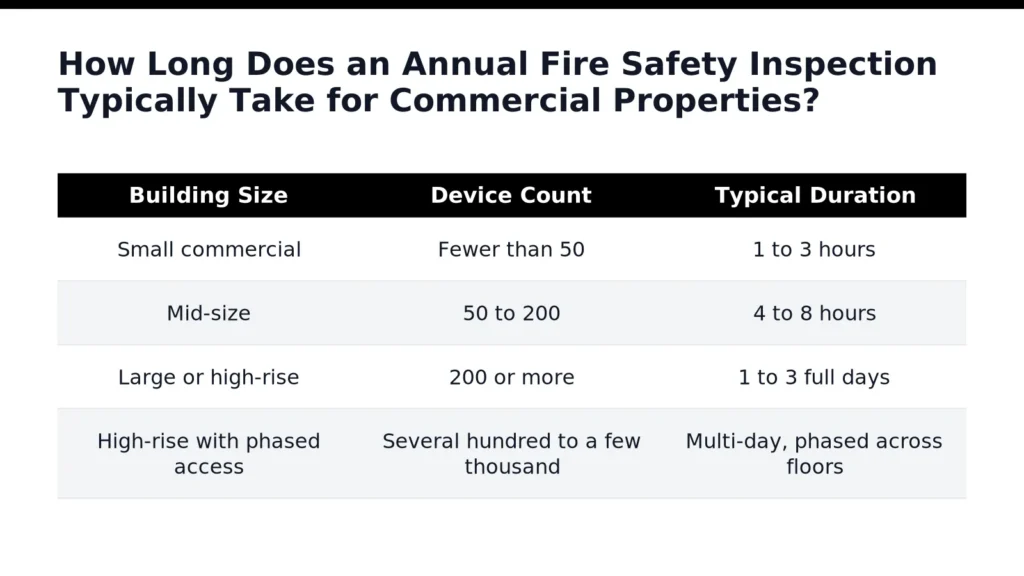
An annual fire safety inspection for a commercial property typically takes between one hour and three full days. The duration depends on device count, building size, and system complexity. A small commercial building with fewer than 50 devices completes inspection in 1 to 3 hours. Mid-size buildings with 50 to 200 devices require 4 to 8 hours. These figures come from Aura Fire Safety’s published inspection timeline estimates.
Facility managers in Abu Dhabi and Al Ain should treat these ranges as working estimates, not fixed timelines. Access issues, older equipment, and integration testing with elevators or HVAC systems extend inspection duration. A high-rise with several hundred to a few thousand devices, multiple risers, and tenant spaces scheduled individually becomes a multi-day job. Such inspections are usually phased across floors or wings over a week or more.
What Factors Extend an Annual Fire Safety Inspection?
Three primary factors push inspection timelines beyond baseline estimates. First, access restrictions in occupied tenant spaces force inspectors to return on separate visits. Second, legacy fire alarm panels without addressable device mapping slow down point-by-point verification. Third, integration testing with elevators, HVAC shutdowns, and door release mechanisms adds hours to each floor cycle.
How Should Property Managers Prepare for Inspection Day?
Property managers reduce inspection time by confirming device counts before scheduling. A building with 75 devices falls into the 4 to 8 hour window, not the 1 to 3 hour range. Amples Fire & Safety LLC, located in Musaffah, Abu Dhabi, serves commercial properties across Abu Dhabi, Al Ain, and the Western Region. The company coordinates with facility teams to phase large-building inspections without disrupting tenant operations. Understanding what to expect from fire safety inspection companies helps managers align staffing and access schedules with ADCD requirements.
| Building Size | Device Count | Typical Duration |
|---|---|---|
| Small commercial | Fewer than 50 | 1 to 3 hours |
| Mid-size | 50 to 200 | 4 to 8 hours |
| Large or high-rise | 200 or more | 1 to 3 full days |
| High-rise with phased access | Several hundred to a few thousand | Multi-day, phased across floors |

What Factors Can Delay Your Inspection Timeline?
Several factors stretch an annual fire safety inspection beyond its typical window. Access issues, older equipment, and integration testing with elevators and HVAC systems all push the timeline longer. Aura Fire Safety identifies these as the primary delay drivers for commercial properties.
Property managers who understand what drives the timeline coordinate tenants more effectively. Scheduling building access in advance prevents inspections from stretching across unplanned days. The annual inspection applies to all buildings owned, operated, or leased by a public-school district, a charter school, BOCES, or nonpublic school, per New York State Education Law Section 807-a.
What Access Issues Slow Down an Inspection?
Locked mechanical rooms, occupied tenant spaces, and restricted roof access force inspectors to wait or reschedule. Each blocked area adds time to the overall process. Facility managers should confirm all access points before the inspection date.
How Does Older Equipment Affect the Timeline?
Legacy fire alarm panels and aging sprinkler components require more testing time. Inspectors must verify each device manually when systems lack modern addressable technology. Integration testing with elevators and HVAC systems adds further complexity to older installations.
Amples Fire & Safety LLC maintains 100 employees, providing a substantial team to manage complex inspection schedules across Abu Dhabi and Al Ain. The company’s ADCD-approved technicians address equipment-related delays through systematic pre-inspection checks.
**** The answer depends on preparation. Buildings with clear access, updated equipment, and documented maintenance records complete inspections faster. Properties with unresolved access issues or aging systems face extended timelines that disrupt tenant operations.
How Do You Prepare to Avoid Inspection Delays?
Preparation prevents inspection delays and protects commercial properties from compliance failures. Abu Dhabi’s regulations ensure a secure environment through strict compliance standards, integrating fire safety into every element of building management. Facility managers who neglect preparation risk failed inspections, costly re-inspections, and operational downtime.
A structured preparation sequence reduces surprises on inspection day. Follow these steps in order:
- Verify documentation completeness. Confirm all prior inspection reports, maintenance logs, and certification records are current and accessible. The annual inspection report must be filed with the Commissioner of Education, emphasizing the importance of proper documentation.
- Test all fire alarm devices. Activate manual pull stations, smoke detectors, and notification appliances. Confirm signals reach the monitoring station without delay.
- Inspect sprinkler system components. Check control valves, pressure gauges, and sprinkler heads for corrosion, obstruction, or physical damage. Amples Fire & Safety LLC specializes in the precise design and installation of state-of-the-art fire sprinkler systems, ensuring properties are equipped with the most advanced protection.
- Clear access paths. Remove stored materials blocking riser rooms, valve stations, and electrical panels. Inspectors require unobstructed access to every system component.
- Schedule a pre-inspection walkthrough. Engage a certified contractor to identify deficiencies before the official inspection. Understanding what to expect from fire safety inspection companies helps facility managers anticipate inspector requirements.
What Documentation Do Inspectors Require?
Inspectors verify maintenance records, test certificates, and prior inspection reports. Missing paperwork triggers immediate delays regardless of equipment condition. Facility managers should maintain a dedicated compliance file updated after every service visit.
Does the Hassantuk System Affect Inspection Readiness?
The Hassantuk Fire Alarm System provides additional security through direct Civil Defense connectivity. Amples Fire & Safety LLC installs this system to strengthen compliance. A functioning Hassantuk connection demonstrates proactive adherence to Abu Dhabi’s regulatory framework.
FAQ
What factors affect the duration of a commercial fire safety inspection?
Building size and system complexity determine the duration. Small buildings with fewer than 50 devices take 1 to 3 hours, mid-size buildings with 50 to 200 devices take 4 to 8 hours, and large buildings with 200 or more devices take 1 to 3 full days.
What does the annual fire safety inspection cover?
The inspection covers life safety code, fire prevention protocols, and certification processes. It tests sprinkler systems, fire alarms, emergency equipment, fire extinguishers, emergency lighting, exit signage, and evacuation routes.
Conclusion
The inspection timeline ultimately reflects the property’s preparation level, not just its size. Facility managers who verify documentation, clear access paths, and complete pre-inspection walkthroughs position their buildings for the shortest possible on-site duration. Those who defer maintenance or leave access unresolved should expect extended timelines and potential compliance failures. Treat the annual inspection as a year-round process. The on-site visit becomes a confirmation of readiness rather than a disruption.