
What to Expect From Fire System Tests in Abu Dhabi: A Practical Guide to Inspection, Compliance and Ongoing Maintenance
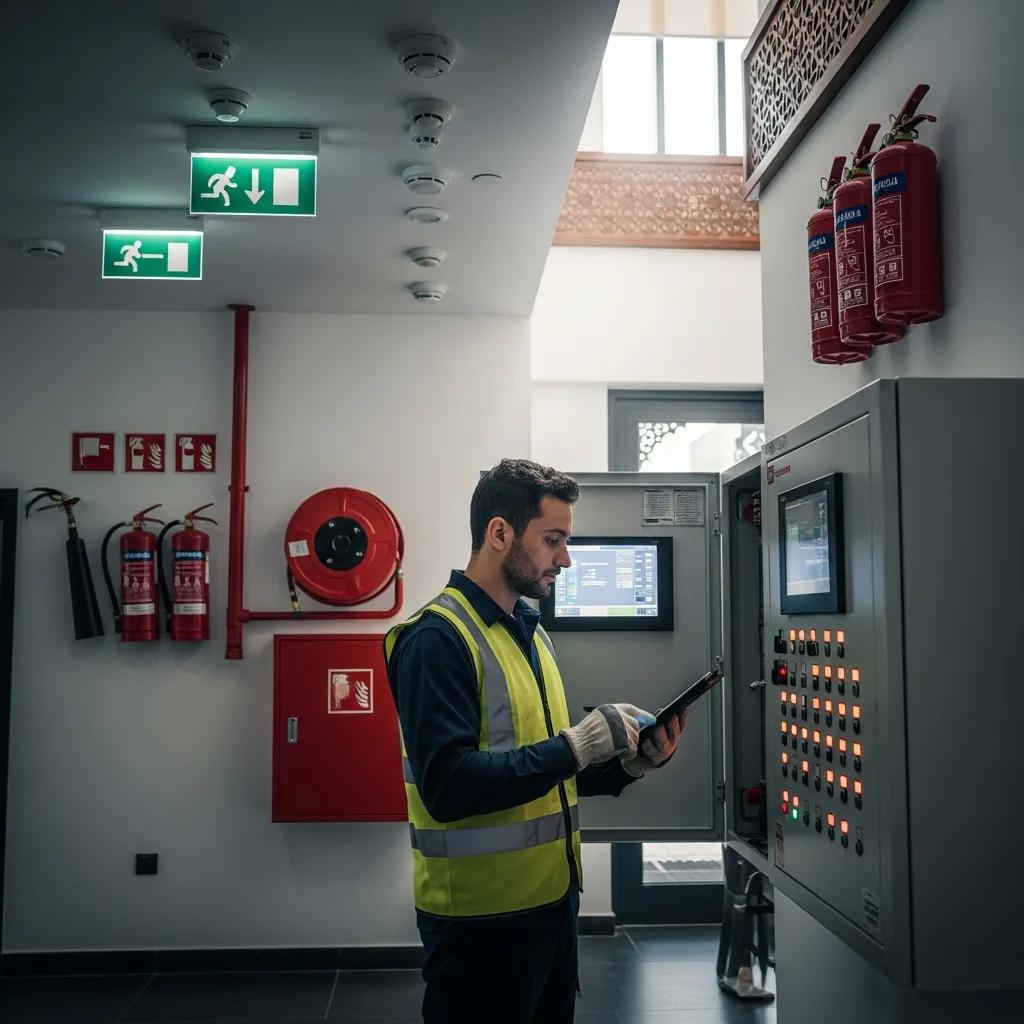
Annual fire system tests in Abu Dhabi confirm that alarms, suppression systems, emergency lighting and monitoring devices are working reliably to protect people and property and to meet Abu Dhabi Civil Defence (ADCD) rules. This guide lays out what technicians inspect, why accurate test records matter for the fitness certificate, and how regular testing protects business continuity and insurance cover. You’ll find step-by-step checks for alarm panels, smoke and heat detectors, sprinkler and pump testing, portable extinguisher servicing, emergency lighting duration tests and Hassantuk connectivity checks. Practical checklists and EAV-style tables identify components, test methods, pass criteria and common corrective actions used during inspections. Finally, we explain how to assess accredited Annual Maintenance Contract (AMC) partners so facility managers can pick a provider that minimises downtime, supplies ADCD-ready documentation and provides fast on-site fixes when faults occur.
Why Are Annual Fire System Tests Essential for Abu Dhabi Businesses?
Annual fire system tests are scheduled inspections and functional checks that confirm detection, alarm, suppression and emergency systems operate as intended and stay compliant with local regulations. Regular testing catches degraded sensors, weak batteries, corroded valves or blocked sprinkler heads before they become critical failures — protecting people and avoiding expensive downtime. From a compliance perspective, documented annual tests underpin the ADCD fitness certificate and meet insurer expectations for preventative maintenance and risk reduction. Below we explain how routine tests build traceable evidence for regulators and speed remediation when inspectors identify issues.
How Do Fire System Tests Ensure Safety and Compliance?
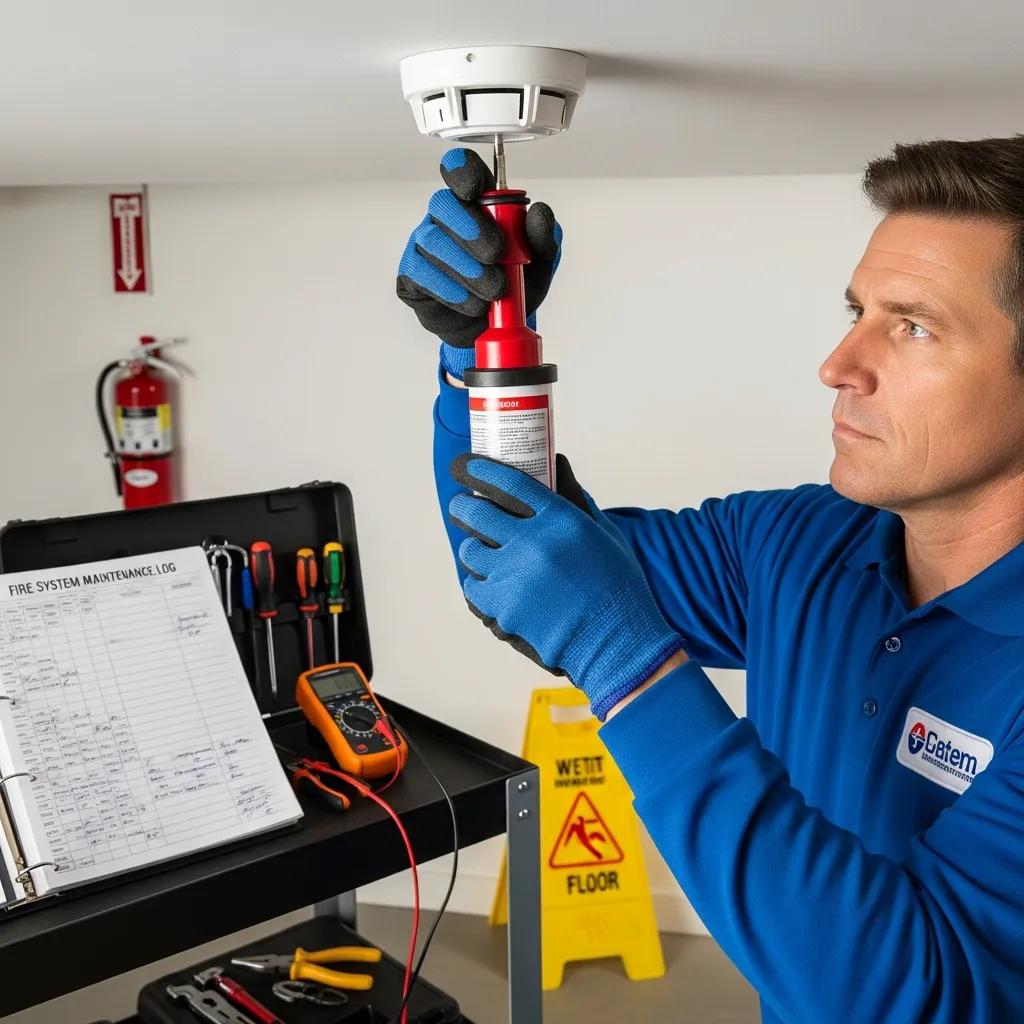
Fire system tests combine live activation, diagnostic scans and record checks to verify system readiness and regulatory compliance. Technicians simulate alarms, exercise detectors, review control-panel event logs and test backup power so alarm chains and notification devices perform under normal and fault conditions. Tests also include physical inspections of suppression components and validation of maintenance tags and service records — together these form the documented history ADCD inspectors expect. A complete maintenance record shows an ongoing upkeep programme, reduces the chance of inspection failure and shortens remediation time when issues are found.
What Are the Key Benefits of Professional Fire System Maintenance?
Professional fire system maintenance brings technical expertise, specialised test equipment and standardised reporting that casual or in-house checks often lack. Certified technicians use calibrated tools to measure detector sensitivity, pump flow and battery capacity, and deliver ADCD-ready reports with timestamps, readings and recommended corrective actions. Outsourced maintenance gives predictable scheduling that prevents missed inspections and lowers long-term costs through early fault detection and planned part replacement. Faster fault resolution and formal certification documents help preserve operations and limit liability exposure.
What Are the Abu Dhabi Civil Defence Requirements for Fire System Testing?
ADCD requires building owners to keep fire safety systems in code-compliant condition and to provide evidence when applying for or renewing the Annual Fire Safety Fitness Certificate. Inspectors commonly review test records, service reports, commissioning documents and proof of corrective actions; systems connected to monitoring centres must show reliable connectivity and alarm reporting. Facilities should keep a central log of service reports and ensure technicians are certified and able to present calibration and component certificates on request. The numbered steps below outline the typical fitness certificate workflow and the paperwork ADCD expects during inspection.
- Gather and compile complete service records for every fire system.
- Conduct a pre-inspection review to confirm compliance and fix obvious faults.
- Book the ADCD inspection, present on-site documentation and address any issues raised.
- Submit corrected findings and updated service logs for final ADCD sign-off.
| System Category | ADCD Requirement / Frequency | Documentation Needed |
|---|---|---|
| Fire alarm systems | Annual functional test; periodic component checks | Test logs, detector sensitivity reports, control panel event logs |
| Sprinkler & suppression | Annual inspection and flow test | Valve exercise records, flow test data, tamper switch reports |
| Fire pumps & tanks | Annual flow and pressure test | Pump curve verification, gauge readings, tank level records |
| Emergency lighting | Annual duration test and routine checks | Duration logs, battery health reports, luminaire inventory |
| Monitoring connectivity (Hassantuk) | Ongoing connectivity verification | Connectivity test records, monitoring center confirmation |
Keeping these documents centrally and accessibly stored streamlines ADCD inspections and reduces the time needed to issue or renew the fitness certificate. Certified AMC providers can package these deliverables to preserve continuous records and ADCD readiness.
For many facilities, a certified Annual Maintenance Contract (AMC) reduces the administrative load of assembling ADCD documentation and supports compliance with scheduled testing, corrective-action tracking and compliance-ready reporting. An AMC provider typically manages pre-inspection preparation and supplies the evidence ADCD inspectors expect, which shortens the certificate approval process.
How Does the ADCD Regulate Fire Safety Inspections and Certifications?
ADCD inspects systems for operational readiness, accurate documentation and evidence of continuous maintenance, with focus on detection reliability, suppression integrity, emergency lighting and monitoring connectivity. Inspectors will sample detectors, review control-panel logs for faults, confirm valve positions and tamper seals, and test emergency-lighting duration to ensure escape routes meet illumination standards. Common causes of failed inspections are missing service logs, expired test tags, poor communication with monitoring centres and unresolved repair recommendations. Presenting complete certified technician reports and demonstrating corrective actions during inspection significantly lowers the risk of non-compliance findings.
What Is the Process to Obtain an Annual Fire Safety Fitness Certificate in Abu Dhabi?
Securing an ADCD fitness certificate normally follows three phases: preparation, inspection and certification. In preparation, facilities compile recent service reports, correct obvious faults and verify monitoring connectivity — often with a technical pre-check by certified technicians. The inspection phase is carried out by ADCD personnel who review records and test system performance on site; any non-conformities become remediation items. After corrections, facilities submit updated documentation and rebook inspection if required; successful verification results in the issue or renewal of the fitness certificate. Timelines depend on remediation scope, which is why early testing and a documented AMC are advisable.
What Happens During Fire Alarm System Testing in Abu Dhabi?
Fire alarm system testing follows a methodical sequence of activation tests, diagnostics and verification checks to confirm detectors, control panels, manual call points, notification devices and backup power work together to detect and alert occupants. A typical sequence begins with control-panel health checks, continues with detector activation tests, verifies notification devices and finishes with log review and documentation. Safety measures are used to avoid false evacuations or service interruption — for example isolating zones or testing during low-occupancy windows. The steps below outline a technician’s workflow for a full alarm-system test.
- Review control-panel diagnostics and confirm firmware, fault logs and battery condition.
- Activate individual smoke and heat detectors to verify sensitivity and response.
- Test manual call points, sounders, strobes and logging accuracy, documenting each result.
This step-by-step approach validates every link in the alarm chain and produces clear, ADCD-ready records of test results and remediation plans.
| عنصر | Test Type | Expected Outcome |
|---|---|---|
| كاشف الدخان | Activation/sensitivity test | Detector triggers alarm and logs the event |
| Heat detector | Heat simulation test | Detector trips within the calibrated threshold |
| لوحة التحكم | Diagnostic & battery test | No active faults; backup power functional |
| Manual call point | Activation test | Alarm initiates and log records the event |
| Sounder/Strobe | Notification test | Audible and visual devices operate at required levels |
The table makes clear which component tests are performed and the specific outcomes that constitute a pass. Clear documentation of these results is vital for ADCD inspections and ongoing system reliability.
How Are Smoke and Heat Detectors Tested?
Technicians test smoke and heat detectors using calibrated test aerosol or controlled heat sources, measuring response time and sensitivity against manufacturer and ADCD thresholds. Point smoke detectors receive brief aerosol exposure to confirm activation without contamination, while beam detectors are checked for alignment and optical sensitivity. Heat detectors are exposed to measured thermal sources to verify trip thresholds and detect drift or contamination. Results are logged with timestamps and serial numbers; any detector that fails sensitivity or response criteria is cleaned, repaired or replaced and retested.
What Are the Steps for Testing Fire Alarm Control Panels and Manual Call Points?
Control-panel testing starts with a comprehensive diagnostic scan of event logs, firmware integrity and power supply condition, including battery backup load testing under simulated alarm conditions. Technicians confirm each input zone maps correctly to field devices and that event logging records accurate device identifiers and timestamps for every activation. Manual call points are operated sequentially to verify they trigger the correct alarm condition and that reset procedures restore normal status. After activations, the system is reset, any faults are cleared and a consolidated report is produced for facility records and ADCD review.
How Is Firefighting Equipment Maintained and Tested in Abu Dhabi?
Firefighting equipment maintenance covers sprinkler inspections, fire pump flow and pressure tests, water tank checks, valve and tamper-switch verification and portable extinguisher servicing. Each category uses specific procedures and measurement criteria to confirm readiness and ADCD compliance. Inspections emphasise physical condition, correct placement, unobstructed sprinkler heads, proper valve alignment and verified flow-switch signals. The table below summarises common inspection steps, pass criteria and typical remedial actions for key suppression equipment.
| معدات | Inspection Steps | Pass Criteria |
|---|---|---|
| Sprinkler system | Visual head inspection; flow/pressure test | No corrosion or blockage; required flow achieved |
| مضخات إطفاء الحريق | Flow and pressure test; coupling & priming check | Pump meets curve; automatic start functions correctly |
| Water tank | Level check; contamination inspection | Adequate reserve and clean water supply |
| Control valves | Exercise and tamper switch test | Valves operate freely and tamper signals are active |
| Extinguishers | Visual check, pressure gauge inspection, tagging | Intact seals, correct pressure and updated tags |
This table helps facility managers and technicians prioritise tests and track whether items meet pass criteria or need immediate remedial action to keep systems compliant and ready.
What Does Fire Sprinkler System Inspection Include?
Sprinkler inspections cover visual checks of heads for corrosion or paint, pipe condition assessments, clearance and orientation verification, and measured flow and pressure tests at test risers. Technicians exercise control valves and confirm tamper and flow-switch signals that feed the alarm system. Flow test results are compared to design curves or minimum thresholds to validate hydraulic performance, while visual inspections identify mechanical damage or obstructions. Any deficiencies — blocked heads, leaking joints or faulty valves — are recorded with remediation recommendations and retesting schedules.
How Are Fire Extinguishers Inspected and Recharged?
Portable extinguisher servicing starts with a visual inspection of the cylinder, hose/nozzle, pressure gauge and safety pin, followed by updating service tags to record maintenance. Extinguishers showing pressure loss, corrosion or broken seals are recharged or replaced; some require hydrostatic testing per manufacturer guidance. Routine checks include verifying agent weight, nozzle condition and accessibility, while extended maintenance records the recharge date and next service interval. Accurate tagging and service records are essential for ADCD inspections and to ensure extinguishers are ready for use.
How Are Emergency Lighting and Hassantuk Systems Tested for Compliance?
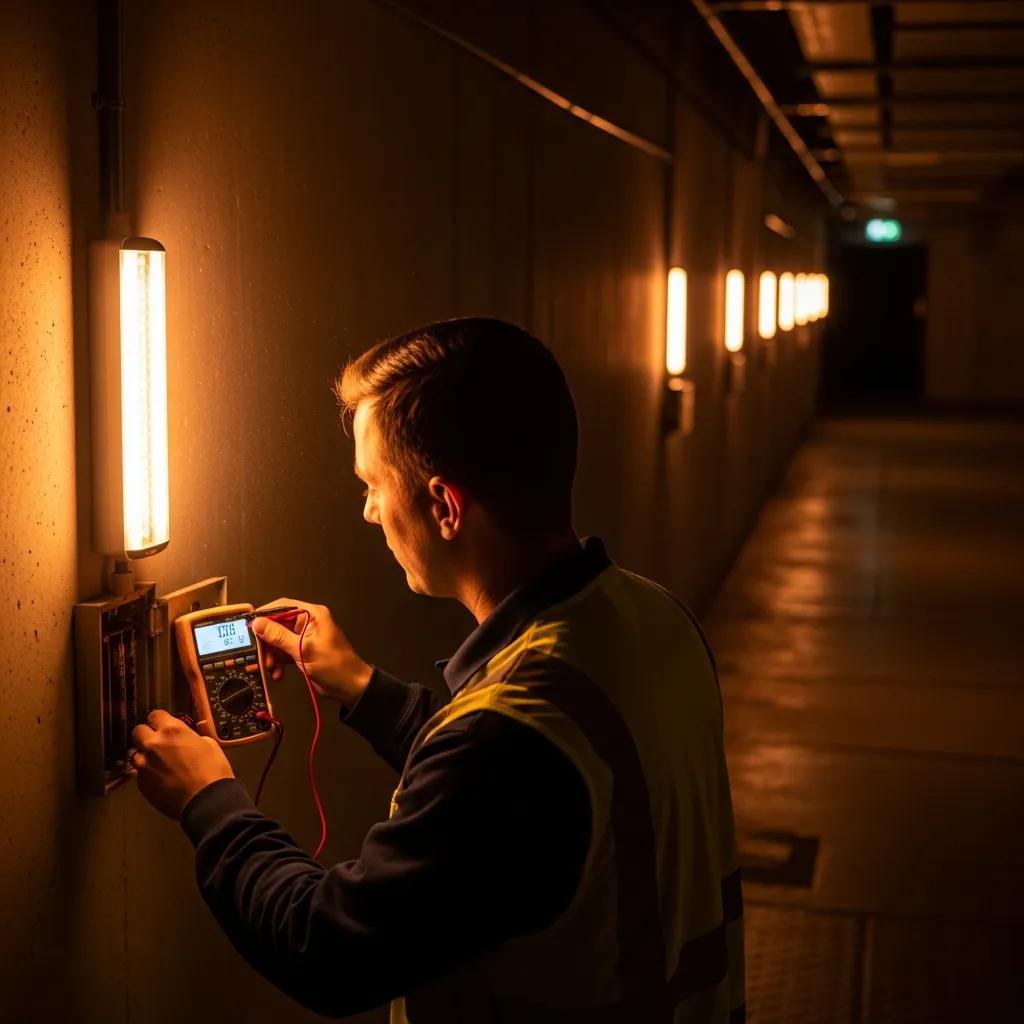
Emergency lighting and Hassantuk monitoring are vital to occupant safety and alarm verification; both require defined tests and records to meet compliance. Emergency-lighting tests focus on full-duration checks, battery health, luminaire condition and escape-route illumination. Hassantuk verification confirms device health, GSM or communications performance, signal strength and successful alarm transmission to the national monitoring centre. The sections below describe duration testing and step-by-step Hassantuk connectivity checks.
What Are the Procedures for Emergency Lighting System Checks?
Emergency-lighting procedures include short functional checks and an annual full-duration test to confirm battery reserve meets the required runtime for escape routes. Technicians measure lux levels at key points, inspect luminaires and exit signage, and test battery charging circuitry under load. Battery capacity is verified using controlled discharge equipment to confirm the system maintains required illumination for the rated duration; failing batteries are scheduled for replacement. All checks are logged with luminaire IDs and runtime results to evidence compliance during ADCD review.
How Is the Hassantuk System Verified and Connected to Monitoring Centers?
Hassantuk verification begins with device health checks — firmware version, power supply and telemetry status — followed by communication tests to confirm GSM signal strength and successful event transmission. Technicians trigger test alarms and confirm receipt with the monitoring centre to ensure end-to-end notification paths are working and event identifiers match the facility’s registered details. Common connectivity issues include weak signal areas or SIM/module faults; technicians document troubleshooting steps and repeat verification until monitoring confirmation is obtained. Accurate connectivity logs are essential for ADCD inspections and uninterrupted alarm monitoring.
How to Choose the Right Fire System Testing Partner in Abu Dhabi?
Choosing a fire system testing partner means checking certifications, ADCD approval, technician qualifications, available test equipment, response times and the quality of documentation and reporting. A reliable provider will deliver ADCD-ready reports, a regular test schedule and clear remediation plans that prioritise occupant safety and regulatory compliance. The checklist below summarises five core criteria to evaluate prospective partners and illustrates the benefits of a certified AMC versus ad-hoc or in-house checks.
- Confirm the provider follows ADCD-recognised procedures and supplies inspection-ready documentation.
- Ensure the company has calibrated test equipment and can do flow, pressure, battery and detector sensitivity tests.
- Verify response times and on-site rectification capability for urgent system faults.
- Check whether the provider offers scheduled AMC services with routine record-keeping and follow-up remediation.
- Request sample reports to review clarity, timestamps and component-level test readings.
What Makes Amples Fire & Safety LLC a Trusted Provider?
At Amples Fire & Safety LLC we deliver annual maintenance services and AMCs for firefighting systems. Our strengths include rapid response, on-site rectification and an experienced in-house technical team. We support ADCD readiness through scheduled maintenance, clearly documented test reports and on-call attendance to resolve faults that could affect certification. These capabilities reflect what facility managers need to maintain compliance and operational resilience. To review Amples’ full service scope and AMC coverage, facility managers can consult our published service details for specifics on deliverables and documentation practices.
How Does Professional AMC Service Compare to In-House Fire System Checks?
A professional AMC provides standardised procedures, certified technicians, calibrated equipment and formal reporting — capabilities that typically exceed intermittent in-house checks. AMCs usually include scheduled inspections, prompt corrective action and ADCD-ready documentation, which reduces administrative and technical burden on facility teams. In-house checks may lack specialised tools and comprehensive record-keeping, increasing the risk of undetected degradation and non-compliance. The comparison below highlights key differences in capability and compliance assurance.
- التوثيق: AMCs deliver formal, timestamped reports formatted for ADCD inspection; in-house records are often informal.
- القدرة التقنية: Professional technicians use calibrated instruments and follow standardised protocols; in-house teams may lack specialised tools.
- Response & Remediation: AMCs usually provide structured remediation paths and faster on-site fixes compared with reactive in-house efforts.
For facilities seeking consistent compliance and reduced ADCD preparation overhead, an AMC consolidates testing, remediation and documentation to simplify the fitness-certificate lifecycle. Facility managers should request sample reports and detailed service scopes to ensure alignment with ADCD requirements before signing a contract.
الأسئلة الشائعة
What types of fire systems are typically tested during inspections in Abu Dhabi?
Inspections in Abu Dhabi commonly test fire alarm systems, sprinkler and suppression systems, fire pumps, emergency lighting and monitoring connectivity (Hassantuk). Each system has specific tests — alarms for sensitivity and response, sprinklers for flow and pressure — to ensure all components work together to protect life and property.
How often should fire system tests be conducted in Abu Dhabi?
Fire system tests are typically required annually under ADCD rules. Some components need more frequent attention — for example monthly extinguisher checks and quarterly emergency-lighting inspections. Regular testing detects issues early and keeps systems operational and compliant. Facility managers should maintain a testing schedule and corresponding records.
What documentation is required for fire system testing compliance?
To meet ADCD requirements, facilities must keep comprehensive documentation of all fire system tests: service reports, test logs, calibration records and evidence of corrective actions. Records should include test results, timestamps and technician signatures. Well-organised documentation supports inspections and the renewal of the Annual Fire Safety Fitness Certificate.
What are the consequences of failing a fire system inspection?
Failing an inspection can prevent issuance or renewal of the Annual Fire Safety Fitness Certificate, which may affect legal operation. Non-compliance can lead to fines, increased liability and possible facility closure until issues are resolved. Unaddressed deficiencies also compromise occupant safety. Facility managers should act quickly on remediation recommendations to restore compliance.
Can in-house staff perform fire system tests, or is professional service required?
In-house staff can carry out basic checks, but professional service is recommended for full testing and compliance. Certified technicians have the expertise, specialised equipment and ADCD knowledge to perform thorough inspections and deliver standardised documentation. Relying only on in-house checks increases the risk of missed issues and non-compliance.
What should facility managers look for when selecting a fire system testing partner?
Facility managers should choose providers with ADCD approval, certified technicians and a proven compliance record. Evaluate their documentation turnaround, response times for urgent issues and access to specialised testing equipment. A dependable partner will offer scheduled maintenance, clear remediation plans and transparent reporting to keep systems compliant and safe.
خاتمة
Regular fire system tests in Abu Dhabi are vital for safety, compliance and operational continuity. Understanding the testing process and maintaining complete documentation helps facility managers meet ADCD requirements with confidence. Partnering with a certified maintenance provider streamlines compliance and improves system reliability. Take the next step to protect your facility by reviewing our comprehensive fire system testing and AMC services.